
Skip to content
Penjams
  • Home
  • Blog
    • Conservative
    • Dialectic
    • Philosophy
      • Ethics
      • Liberty
      • Voting
      • Free-will
    • Theology / Religion
    • Story
    • Other Worlds
    • – Guest Posts
    • – Serial
    • – Poems
  • Podcast
  • Links
  • About
  • Thanks!
    • Buy Me a Coffee
    • Amazon Link (Shopping from it helps out.)
    • Guest Posting and More

Neighboring Faiths

Posted on March 12November 14

This is a bit of my episode with Dr. Win Corduan in which we talk the latest edition of his book Neighboring Faiths. Hear the whole episode below. Enjoy.

Penjammin: Oh, I have a list of things I wanted to ask you, but mostly I want to talk about your book, which is not about elves or dwarves or anything like that. Some people probably still believe in them, so maybe in a future edition. Right? [laughter] It's Neighboring faiths. Why this book, and how is it distinct from others?

Win: In the 90s, if you were looking for a book in world religions to use as a textbook in your class at a Christian college, your choice was between books that were motivated by various agendas (all religions are the same or maybe the original religion of humankind was the worship of Mother God and so forth). And having been placed in the situation by the Lord that I needed to teach world religions . . . I started to study for that to make my teaching worth while more and more and more. Then finally, I got to the point where some students were encouraging me to write that book, and I thought about it, and I approached InterVarsity press with the idea of writing a book from a Christian perspective, and they went along with that. And so I wrote the first edition, and thankfully, the Lord has blessed that. So now up to the third edition, and I don't know if there will be any more.

Win: You know, I think that as a Christian who makes no pretense of being anything else, who even prefaces his book with reflections on Christianity and world religions, I can give a fairer and more objective picture of what others believe than those who think it's all the same pudding just in different cups.

Penjammin: Yeah, yeah.

Win: I distance myself from, say, Buddhism and Hinduism. It's not my religion. I can give an objective description of both rather than looking for a nonexistent common core.

Penjammin: That's interesting because it also points out that the perspective that the religions all have this common core, that they all melt down to pretty much the same thing, that is just as much of an assumption or a presumption or a slanting bias, potentially, as anything else would be. And it seems like that's assumed to be the objective point, when really it's one other view, right?

Win: Right. It becomes almost a religion in itself. When you say that we really don't worship Jesus, but we all worship “The Real”; we just don't know it, as a Christian, I feel like I'm being shortchanged. I think most people would think the same.

Penjammin: Right. That's interesting when the “neutral” person says something like that, and then every other adherent of a religion says, “No, you got us wrong!”

Win: Yeah.

Penjammin: Like, Wait a minute. Everyone disagrees with your [analysis]? Maybe it's you.

Win: From the first edition on, from the very start, I had for each religion, the section . . .

Here more below.

  • wincorduan.com
  • Neighboring Faiths
  • streetjelly.com

Penjammin grew up in a labyrinthine cavern. Later he ran with the wolves and lived every moment marinated in the sweet scent of his game, until pirates landed and… See About for full story, and get his eletter at penjams.com/subscribe.
Systematic Philosophical Theology

Posted on February 28November 14

This is a bit of my episode with Alex from The Protestant Libertarian Podcast in which we talk William Lane Craig's new book Systematic Philosophical Theology Vol. 1. Hear the whole episode below. Enjoy.

Penjammin: So what'd you think about this book in general? We're talking about, by the way, William Lane Craig's book just coming out with a multi-volume series of a systematic theology, and it's called Systematic Philosophical Theology. So for those listening in, there's a little courtesy heads up for you. What did you think about it?

Alex: I'm familiar with William Lane Craig's work. I have a lot of respect for him. I think he's a brilliant intellectual. There are some issues of course [that] I haven't agreed with him on in the past, but that's okay because I respect his output. And I think that in general he's on the right track. And I'm also not really a systematic theology guy. My background is in biblical studies, which, as William Lane Craig talks about in the book – I know he has a section where he quotes Ben Witherington and I think Brevard Childs, when he talks about how there's a difference between I guess, the theology that emerges out of biblical studies and then trying to systematize that theology into this, this kind of orderly structure, which is what he's trying to do with his book. So I obviously I do read a little bit of systematic theology for the podcast, and I have an interest in certain issues, and I'll read what the systematics think, but I'm not an expert on that by any stretch of the imagination. But it seems, at least with the Prolegomenon the introductory section of the book, he is laying out this kind of grand picture for a way of rationally systemizing theology based on kind of strict philosophical reasoning. And one of the things that I really appreciate about what he incorporates in the Prolegomena is the idea that this has to conform to what we find in the Scripture.

Alex: And he actually has this really great passage, which maybe we'll talk about in a little bit, where he discusses how actually our reading of the Bible has to be the starting point for any systematic theology. And this has always been one of my problems with systematic theology is that, as I've read some of this, it almost seems like the systematic theologians, they're born into a particular tradition, whether it's the Lutheran tradition or the reformed tradition or whatever tradition, the Catholic tradition. And instead of using the Bible to critique their tradition, you know, the kind of reading their tradition through the lens of the Bible, what they do is they read the Bible through the lens of their tradition. So you wind up having a Lutheran reading of the Bible or a reformed reading of the Bible. And I just think that as a Protestant who believes in the ultimate authority of Scripture, that should be our balance for us. Our starting point should be the Scripture, and we should work forward from there. And that's exactly what William Lane Craig argues in this book. And so I think that this might give him a huge advantage as a systematic theologian in this series. And so it'll be really interesting to see where he takes it in the long run. But knowing his work, I think he's going to do a great job with it.

  • Alex: x.com/Prolibertypod
  • Alex's Podcast: libertarianchristians.com/shows/protestant-libertarian-podcast
  • The Book: Systematic Philosophical Theology, Volume 1: Prolegomena, On Scripture, On Faith

Penjammin grew up in a labyrinthine cavern. Later he ran with the wolves and lived every moment marinated in the sweet scent of his game, until pirates landed and… See About for full story, and get his eletter at penjams.com/subscribe.

Misrepresentation Sucks

Posted on February 21November 14

Some lies just won’t die, like the idea that the ancient Israelites got their monotheism via Zoroastrian influence. If there was any such influence, it was the other way around. That idea gets used as part of a secular account of the origins of the Bible, and all that junk bugs me.

Probably the irritation has to do with seeing it foisted unwittingly on kids at an allegedly conservative Christian university. Conservative objections to such ideas went unmentioned, dismissed by professors along with flat-earthery I suppose. And that’s not where ended! That kind of thought was so rampant that their Easter play intentionally skipped the resurrection. I realize that maybe not every reader of this is Christian, but that kind of thing is gravely wrong for a school that publicly claims to be Christian.

*takes a deep breath*

Anyway, another lie that won’t die has more to do with gossip and slander. Those lies can be devastating.

The author of my current read (Systematic Philosophical Theology) is occasionally accused of believing and advocating the Apollinarian idea that Jesus did not have a complete human nature. In fact, said author does not believe that, but it’s worth saying first that the furthering of such a false accusation without due diligence is wrong and leads others into the same mistake. Pastors should not be guilty of such things. Also, there’s something concerning about how the lie got spread so broadly when few of its carriers even know what Apollinarianism is.

That said, some confusion is understandable since the view William Lane Craig did propose (as a possibility) is called Neo-Apollinarianism. But Craig is quite explicit about what it entails:

“What I argue in my Neo-Apollinarian proposal is that the Logos brought to the human body just those properties which would make it a complete human nature – things like rationality, self-consciousness, freedom of the will, and so forth. Christ already possessed those in his divine nature, and it is in virtue of those that we are created in the image of God. So when he brought those properties to the animal body – the human body – it completes it and makes it a human nature. Against Apollinarius, I want to say that Christ did have a complete human nature. He was truly God and truly man. Therefore his death on our behalf as our representative before God was efficacious.” (Does Dr. Craig Have an Orthodox Christology?, ReasonableFaith.org)

Anyway, none of that stuff has come up in my reading thus far. Christology will be in a later volume. But Pascal’s Wager came up today! And that was a LOT of fun. Get the book yourself or save yourself some money and wait until the price goes down. I’ll try to hold ya over with some good responses in my eletter.

Penjammin grew up in a labyrinthine cavern. Later he ran with the wolves and lived every moment marinated in the sweet scent of his game, until pirates landed and… See About for full story, and get his eletter at penjams.com/subscribe.

“We’re on a Mission from God”

Posted on January 17January 17

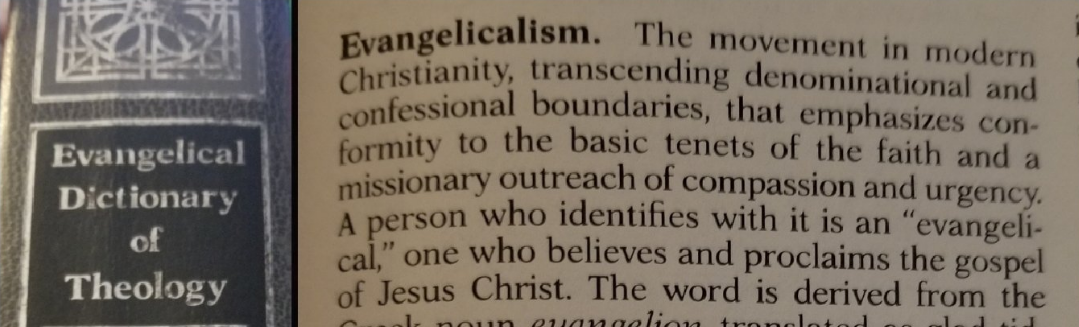
Recently in the Thinklings (my private discussion group), the topic turned to “Evangelicals”. Many definitions of that word have been levied in order to get a handle on just what exactly an Evangelical is. I re-offered my favorite gist and backed it up with this:

Whether one likes that take or not, there’s one thing about it that I was reminded of recently, the missional part, “a missional outreach of compassion and urgency.” And it came to mind in regards to that big book I’m reading: Philosophical Foundations of a Christian Worldview .I mentioned before how I’d be reading the book to prep for the release of a systematic theology by one its authors. Well, one thing that sticks out to me about Philosophical Foundations’ is a missional quality that is beautifully and profoundly present, at least in the introduction. The book leads with a general impulse to “save the mind” as well as the heart. Also the very missional John Wesley is posited as a good role model, and its motivation for the philosophy is missional. It quotes J. Gresham Machen thusly (yes, I wrote “thusly”):

False ideas are the greatest obstacles to the reception of the gospel. We may preach with all the fervour of a reformer and yet succeed only in winning a straggler here and there, if we permit the whole collective thought of the nation or of the world to be controlled by ideas which, by the resistless force of logic, prevent Christianity from being regarded as anything more than a harmless delusion.

The introduction also includes an invitation to dialogue, to dialectic. This book knows how to talk to me. 🙂

Well, I expect to continue reading and writing along these lines for a little while. Feel free to reply with thoughts of your own. And be sure to subscribe to my eletter below. Have a great weekend.

Penjammin grew up in a labyrinthine cavern. Later he ran with the wolves and lived every moment marinated in the sweet scent of his game, until pirates landed and… See About for full story, and get his eletter at penjams.com/subscribe.

Yes, Virginia…

Posted on December 24November 14

Die Hard is a Christmas Movie.

Virginia, your little friends are wrong. They're affected by a skepticism that denies what it can't see. But, yes, Die Hard is a Christmas movie. It's as certain as the Christmasiness of the Christmas wreath or the mistletoe. Do your friends find those to be Christmas decorations? What have those things to do with Jesus or Santa? Maybe they enjoyed Christmas symbolism long ago, but few see that in them today. And yet, thankfully, these things still find a Christmasy place in our hearts. And heavens! Why would we want less Christmasy stuff in our hearts?! Why should fewer things be Christmas things? That just makes Christmas poorer.

Not a Christmas movie?!? You might as well say Home Alone is not a Christmas movie. You could get your father to hire a hundred scientists to examine him under a microscope, and they'd never find a crumb of fatherness, but he is still your father. Likewise, they could break Home Alone down to its every particular and then quantify its relative Christmas quotient in terms of snow, Christmas songs, and Santa references, and they could do the same with Die Hard, but they'd be overlooking some thing huge:

Die Hard has become a part of Christmas.

That show has been so frequently watched over so many many Christmas times that now, on such occasions, it helps people feel a little more Christmasy inside. It has become associated with the holiday. This bit of magic is something that happens to a movie. It is not a part of the movie, so the reductive analyst will never find it. It takes Christmas magic to see it.

Not a Christmas movie?!? Thank God it is. Decades after it was made, it continues to make hearts feel a bit more Christmasy at Christmas time.

Merry Christmas.

Penjammin grew up in a labyrinthine cavern. Later he ran with the wolves and lived every moment marinated in the sweet scent of his game, until pirates landed and… See About for full story, and get his eletter at penjams.com/subscribe.

Older PostsNewer Posts


Subscribe

Recent Posts

  • Storming the Gate
  • They buried the gate.
  • I couldn’t ruin the documentary.
  • Conservatives conserve nothing?
  • Religion Reboot?
  • Apples and Oranges
  • Pushy Puritans Don’t Get a Pass
  • When Lies Lash Out
  • Subjective Professory
  • Silence and Starsong

Quotes

(Loading...)

Penjams.com is a participant in the Amazon Services LLC Associates Program, an affiliate advertising program designed to provide a means for sites to earn advertising fees by advertising and linking to Amazon.com.

  • Subscribe
Copyright © 2026 . All rights reserved.